

Forex When To Buy When To Sell Signals
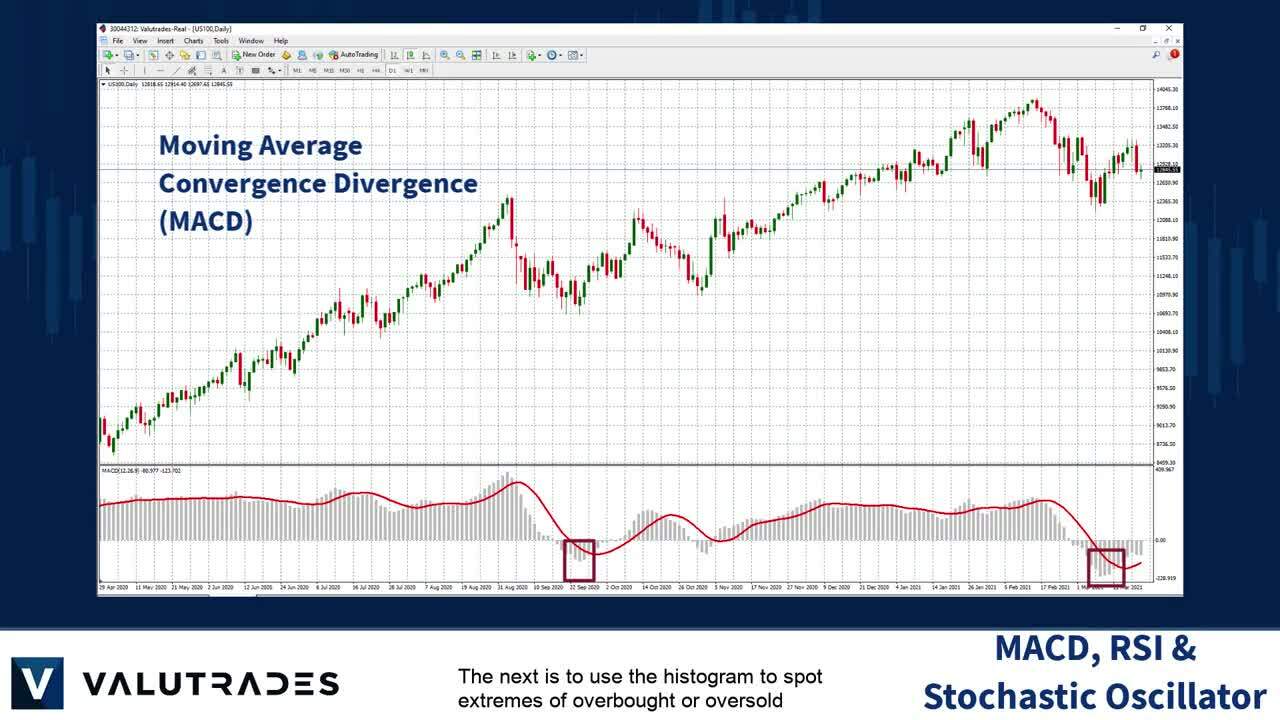
The relative strength index, or RSI, is a price momentum indicator in the same family unit equally the moving boilerplate convergence deviation (MACD) and stochastic oscillator. Like other momentum indicators, the RSI is charted on a dissever graph adjacent to price and has an oscillator range between 0-100. Most traders use the RSI to identify overbought and oversold market conditions and locate trade entry and exit points, only it can besides be used as a divergence indicator. Given their like objectives, shapes, and graphic ranges, it tin be piece of cake to confuse the RSI with the stochastic oscillator—and for skilful reason. Both indicators expect at current endmost prices relative to highs and lows over a stipulated look-back menses. In add-on, both indicators define overbought and oversold levels that traders apply to place purchase and sell signals. The table below shows how the two indicators compare. The differences betwixt the two indicators are subtle and can all-time be understood by examining their respective formulas. The stochastic oscillator examines an asset's current endmost price (C) in relation to its price range of highs (H) and lows (L) over a 14-twenty-four hour period look-back period to determine if the asset is overbought or oversold (or what's known as the %K value). In contrast, the RSI uses relative strength (RS)—or the average gains versus boilerplate losses of the previous 14-day menstruum—to make up one's mind if an asset is overbought or oversold. In outcome, both indicators are looking at previous highs and lows to determine current toll momentum, just they focus on different relationships therein. Information technology'southward as well important to note that the stochastic oscillator consists of ii lines, while the RSI forms only ane. The 2nd stochastic oscillator line (%D) represents a three-twenty-four hour period uncomplicated moving boilerplate (SMA) of %G and is used as a signal line. The overlapping of these 2 stochastic point lines is known as a "crossover" and is unique to the stochastic oscillator. While the default overbought and oversold levels are unlike for each indicator, traders sometimes choose to alter the RSI defaults to lxxx and xx (the same as the stochastic oscillator) for more volatile markets to reduce the occurrence of false signals. The popularity of RSI equally a forex indicator is a product of its distinct advantages every bit a research and evaluation tool. Top benefits of using RSI include: For all of the value RSI offers to forex traders, it isn't foolproof. While many disadvantages of RSI are exacerbated by misuse of this indicator in your trading strategy, there are certain limitations to keep in mind, including: If you're using the default RSI overbought and oversold settings, a signal line move above lxx indicates that an asset is overbought, and a dip below thirty suggests that it's oversold. If the RSI moves below 30 and then crosses back over the oversold line in the opposite direction, it's thought to be a bullish (buy) indicator, with the expectation that prices will rise. Conversely, when the RSI initially moves higher up seventy and and then dips below this overbought line, it'due south understood as a bearish (sell) signal, foreshadowing a drop in price. In the NZD/GBP chart below, notation how the oversold conditions in August are mirrored by an increase in toll: Those oversold conditions speedily swing up into overbought territory in September, after which the price drops and becomes range-bound in the firsthand futurity. In both cases, RSI was accurate in identifying potential shifts in price momentum. While RSI'due south overbought and oversold signals are best read in the greater context of other validating indicators, even novice traders can start using this oscillator to spot preliminary trade opportunities based on overbought conditions. We mentioned earlier in this article that RSI overbought weather are typically defined every bit any instance where a forex pair'south RSI is greater than 80. When this happens, it suggests that the price for a pair has been artificially elevated by consumer demand for this position—meaning that, once the wave of demand dies down, the cost is poised to drop. Although traders should consider what other factors may be contributing to this price movement—including breaking economical and political news—the development of RSI overbought weather could be used as a reliable starting point for deeper research into a potentially lucrative trading position. In the same way that traders can hands identify RSI overbought weather condition, a like approach can be used to pinpoint oversold conditions likely to precede a price correction. In most cases, the level at which RSI signals oversold conditions is marked at twenty, equally mentioned above, although some traders may make up one's mind to adjust this threshold based on their private trading strategy. Equally with RSI overbought atmospheric condition, and oversold forex pair is one that has mayhap seen its price pushed beneath marketplace value due to widespread motility abroad from that position. Oversold conditions could present an opportunity for traders to open up positions at a disbelieve, and steal quick profits through a swing trade once the price and RSI bounciness back to normal levels. Every bit always, traders are encouraged to develop a forex trading strategy that relies on multiple data points when considering the potential value of any position. Overbought and oversold RSI readings are more than authentic when cost is trending sideways (indicating a strong trend) rather than erratically moving upwardly and downwards. For this reason, traders using the RSI seek out trending markets that alternate between overbought and oversold levels but take sustained high and depression periods, as is the example with the EUR/USD chart beneath: To decrease your vulnerability to false signals, it's always best to merchandise in the direction of the tendency. Later you've chosen a currency pair, trace or envision a trend line, and verify all buy and sell signals against the overall tendency management. In an uptrend, be on the lookout man for a bespeak line dip below 30 followed by a rebound in a higher place 30. In a downtrend, focus your sights on peaks above 70 followed by dips below this line. On the chart below, the RSI crosses over the overbought line on multiple occasions, producing a bearish signal. But if the trader were to human action on the signal and bet against the trend direction, they would lose coin long term considering the overall trend remains upward. Forex trading strategy favors averaging up and exercising resilience to small-scale market fluctuations, then most traders invest with the tendency to improve net profit. In short, they exit the trade only when the trend truly moves against them, as confirmed by sustained higher highs or lower lows in price. In the AUD/USD chart below, discover how multiple reaches upwardly into overbought territory go against the overall upwardly trend of the currency pair. These false sell signals could cost traders profit if they don't use other indicators and chart patterns to approve and contextualize RSI data: Yous'll notice that the bearish signals produced past RSI are not entirely "false" in every case. In other words, these movements sometimes represent with a temporary drib in price. But the bearish signal doesn't reveal itself until the RSI drops below 70, at which point the window for profit is fleeting. If a forex trader chooses to invest confronting the trend and sell, they may benefit if they identify a cease close to the entry point and exit with a profit before the uptrend continues. Failure swings refer to instances when the RSI crosses over the overbought or oversold line, reverses to the contrary side, and pulls back again—this time without crossing over the line. The "swing" ends when the RSI breaks its recent low or loftier and continues to tendency in the same direction. Failure swings indicate that the cost trend will reverse; swings at the height of the RSI range (70) are considered sell signals, while swings at the bottom (xxx) of the RSI range are considered buy signals. When a failure swing occurs, the RSI tendency line will also pause. For this reason, some traders choose to draw tendency lines on the RSI oscillator to human activity as leading reversal indicators. Because understanding trend direction is key to reading RSI signals, this indicator is frequently paired with other tendency-following tools such as simple moving averages and tendency-confirming tools such equally the moving average convergence divergence (MACD) indicator. In the case of MACD, RSI can be corroborated when overbought weather condition are paired with MACD'southward identification of difference from price. The alignment of these two indicators is a popular and effective tool for identifying a trade opportunity. Similarly, overbought conditions identified past RSI tin can be verified by the use of average directional index (ADX)—specifically if ADX is trending toward a retracement. 
Comparing RSI vs. Stochastic Oscillator

Advantages of Using RSI in Forex
Disadvantages of Using RSI in Forex
Reading an RSI Graph

Using RSI to Spot Overbought Conditions
How RSI Can Place Oversold Atmospheric condition
Recognizing Forex Opportunities


Understanding Failure Swings
Pairing the RSI with Other Indicators

Disclaimer:
The information provided herein is for general informational and educational purposes merely. It is non intended and should non be construed to plant advice. If such information is acted upon by you lot then this should be solely at your discretion and Valutrades will not be held answerable in whatever manner.

Source: https://www.valutrades.com/en/blog/easy-forex-trading-strategies-buying-and-selling-using-rsi
Posted by: parkerdointow.blogspot.com
0 Response to "Forex When To Buy When To Sell Signals"
Post a Comment